You finished recording. You hit stop. Now you’re staring at a waveform wondering: how long is this actually going to take?
It’s one of the most searched questions in podcasting and one of the least honestly answered. Most guides either wildly underestimate (“just 30 minutes!”) or give vague non-answers that leave you no better off than before you searched.
This post breaks it down with real numbers: by episode length, by editor experience level, and by the type of show you’re running. No fluff. Just benchmarks you can actually plan around.
The Core Rule: Podcast Editing Takes 2 to 5x the Episode Runtime
Before the tables, here’s the single most useful benchmark in audio post production:
For every 1 minute of finished audio, expect to spend 2 to 5 minutes editing.
That multiplier shifts based on three factors: your experience level, the complexity of your show format, and the quality of your raw recording. Let’s put real numbers on each of those.
Editing Time by Episode Length (Beginner vs. Experienced)
The table below assumes a standard interview format podcast with one host and one guest, recorded in a moderately quiet environment.
| Finished Episode Length | Beginner Editor (0 to 1 yr) | Intermediate Editor (1 to 3 yr) | Professional Editor |
|---|---|---|---|
| 15 minutes | 45 min to 1.5 hrs | 30 to 45 min | 15 to 25 min |
| 30 minutes | 1.5 to 3 hrs | 1 to 1.5 hrs | 30 to 50 min |
| 45 minutes | 2.5 to 4.5 hrs | 1.5 to 2.5 hrs | 45 min to 1.25 hrs |
| 60 minutes | 3 to 6 hrs | 2 to 3 hrs | 1 to 1.75 hrs |
| 90 minutes | 5 to 9 hrs | 3 to 5 hrs | 1.5 to 2.5 hrs |
Note: These are editing only estimates. They do not include upload, scheduling, writing show notes, creating graphics, or publishing.
Why Beginners Take So Much Longer: The 5 Time Drains
The gap between beginner and professional in that table is not about raw effort. It’s about specific inefficiencies that compound with every episode. Here’s where the time actually goes:
1. Software Friction (30 to 60 minutes per session)
Audacity, Adobe Audition, GarageBand, Descript. Each has its own workflow, keyboard shortcuts, and quirks. Beginners spend a disproportionate amount of time navigating menus, undoing mistakes, and searching for functions they haven’t memorized yet. Professionals have muscle memory. You don’t, yet.
2. Indecision on Cuts (adds 20 to 40%)
Do you cut that pause? Leave the stutter? Trim the tangent or keep it? Experienced editors make these calls in seconds. Beginners second guess every decision, often replaying segments 3 to 4 times before acting. This alone can add an hour to a 45 minute episode.
3. Audio Correction Loops
Noise reduction applied too aggressively? Now there’s a metallic artifact you need to fix. EQ boosted the wrong frequency? The voice sounds tinny. Beginners frequently apply a fix, listen back, realize something sounds worse, and undo. Sometimes losing previous work in the process. Each loop costs 15 to 30 minutes.
4. No Template or Starting Point
Professionals open a project template: tracks pre configured, compressor settings already dialed in, intro and outro pre loaded. Beginners start from scratch every time. That setup overhead is invisible until you measure it. It typically costs 20 to 40 minutes per episode.
5. The Listening Passes Problem
Beginners tend to do one long slow edit, going line by line. Professionals batch their work: one pass for content cuts, one pass for audio correction, one pass for levels. Batching is dramatically faster. Without knowing this workflow, beginners average 40% more total time on the same episode.
How Show Format Changes the Math
Episode length is only one variable. Show format has an equally large impact on editing time.
| Show Format | Relative Editing Time | Why |
|---|---|---|
| Solo monologue | Baseline (1x) | One track, one voice, minimal coordination |
| Interview (2 people) | 1.3 to 1.5x | Cross talk, level matching between two mics |
| Panel or roundtable (3 or more) | 1.8 to 2.5x | Multiple tracks, frequent interruptions, complex leveling |
| Narrative or scripted | 2 to 4x | Music beds, SFX, precise timing, multiple takes to weave |
| Remote interview (Zoom or Riverside) | +20 to 40% vs. studio interview | Variable audio quality, internet artifacts, sync issues |
If you host a 60 minute panel discussion recorded over Zoom, a beginner could realistically spend 10 to 14 hours on a single episode. That’s nearly two full workdays.
The Hidden Cost Most Podcasters Don’t Count
The hours in the table above assume you sit down and edit without interruption. In practice, that rarely happens. Most podcasters edit in fragments, an hour here, thirty minutes there, which means:
- Re orientation time: Every time you re open a project, you spend 5 to 15 minutes remembering where you were and what decisions you had made.
- Context switching cost: Research consistently shows that switching from creative work like preparing your next episode to technical work like editing and back degrades the quality of both.
- Deadline pressure compression: When you’ve procrastinated and a publish date is looming, edit quality drops. You make rushed decisions you’ll regret when you listen back.
If you’ve read our breakdown of the true cost of DIY podcast editing, you’ll recognize this pattern: the stated time cost is always lower than the real time cost. The gap between “hours I tracked” and “hours I actually spent” is typically 30 to 50% for most podcasters who audit themselves honestly.
What a Professional Editor Does Differently
Speed is not the only benefit of professional editing, but it is the most measurable one. Here’s how professionals achieve 3 to 5x faster turnaround on the same episode:
Template Based Workflow
Every show has a pre built project template. Tracks, plugins, routing, and output settings are configured once and reused. Opening a new episode is a 2 minute setup, not a 30 minute build.
Macro Level Content Editing First
Professionals make all content decisions before touching any audio correction. This prevents the classic beginner mistake of spending 20 minutes perfecting audio on a section that ultimately gets cut.
Keyboard Driven Editing
A professional editor rarely touches their mouse. Every action, set in point, ripple delete, apply fade, zoom in, is a keyboard shortcut. This alone cuts mechanical editing time by 40 to 60%.
Trained Ear Means Fewer Passes
Professionals catch noise issues, level imbalances, and pacing problems in a single listen. Beginners often need 3 to 4 full listens to catch what an experienced editor hears in one.
How to Audit Your Own Editing Time
Before you decide whether DIY editing is sustainable for your show, measure it accurately. Most podcasters dramatically underestimate because they don’t count interruptions, re dos, and setup time.
Run this audit for your next two episodes:
- Start a timer the moment you open your editing software.
- Stop it only when you export the final audio file.
- Record every interruption and estimate the re orientation cost when you resume.
- Include the time you spend watching tutorial videos or troubleshooting problems.
- Multiply your total by 1.3 to account for cognitive overhead you can’t easily clock.
Compare that number against the benchmarks in this post. If you’re at or below the intermediate column, your DIY workflow is reasonably optimized. If you’re in the beginner range or above it, you’re spending time that almost certainly has a higher value use.
For a detailed breakdown of what professional quality editing involves at each stage, see our complete podcast audio editing checklist. It’s a useful reference whether you’re editing yourself or evaluating what a service should be delivering.
The Compounding Effect: What That Time Costs Per Year
Run the numbers on an annualized basis and the picture becomes sharper:
| Publishing Frequency | Episodes Per Year | Beginner (4 hrs per ep) | Intermediate (2 hrs per ep) | Professional (1 hr per ep) |
|---|---|---|---|---|
| Weekly | 52 | 208 hrs per year | 104 hrs per year | 52 hrs per year |
| Bi weekly | 26 | 104 hrs per year | 52 hrs per year | 26 hrs per year |
| Monthly | 12 | 48 hrs per year | 24 hrs per year | 12 hrs per year |
A weekly podcaster editing at the beginner level spends 208 hours per year, the equivalent of five full 40 hour work weeks, on editing alone. That’s five weeks of your year before you’ve done a single hour of content creation, audience development, or monetization work.
Once you’ve mapped your own time against that number, the question shifts from “can I afford professional editing?” to “can I afford not to have it?”
If you’re consistently running into the growth ceilings that come with an inconsistent publishing schedule or variable audio quality, it’s worth reading our post on the 7 mistakes keeping podcasts from growing. Several of them trace directly back to the time burden of DIY production.
The Bottom Line
Editing time benchmarks for a standard 45 minute interview podcast:
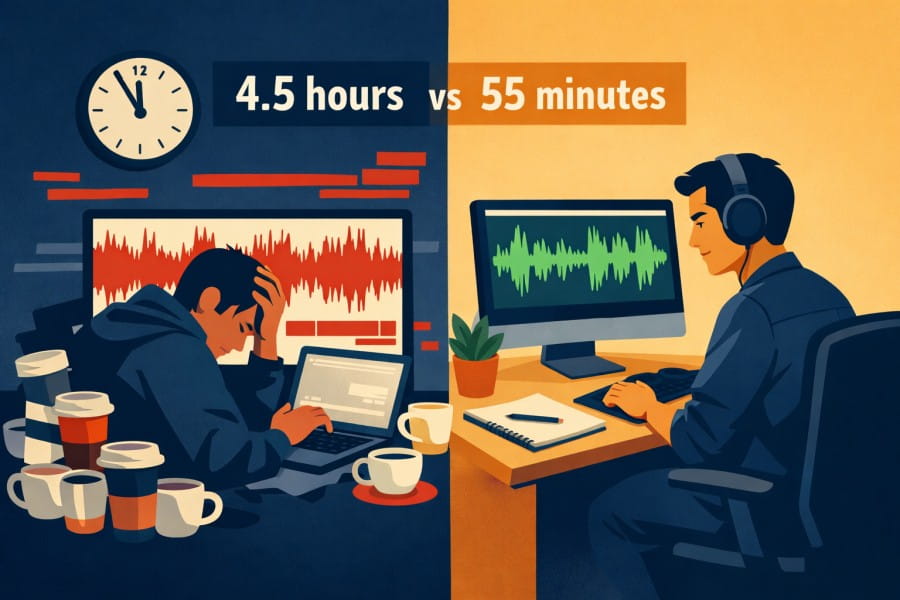
- Beginner (DIY, first year): 2.5 to 4.5 hours per episode
- Intermediate (DIY, optimized workflow): 1.5 to 2.5 hours per episode
- Professional editor: 45 minutes to 1.25 hours per episode
The gap is not about working harder. It’s about tools, templates, trained ears, and thousands of hours of pattern recognition that professionals bring to every session.
If your current editing time is pulling you away from the work only you can do, recording, building an audience, developing your niche, that’s the clearest signal that it’s time to hand it off.
Want to know exactly what professional podcast editing covers and what it should cost? See how Podsmiths handles your episodes end to end.