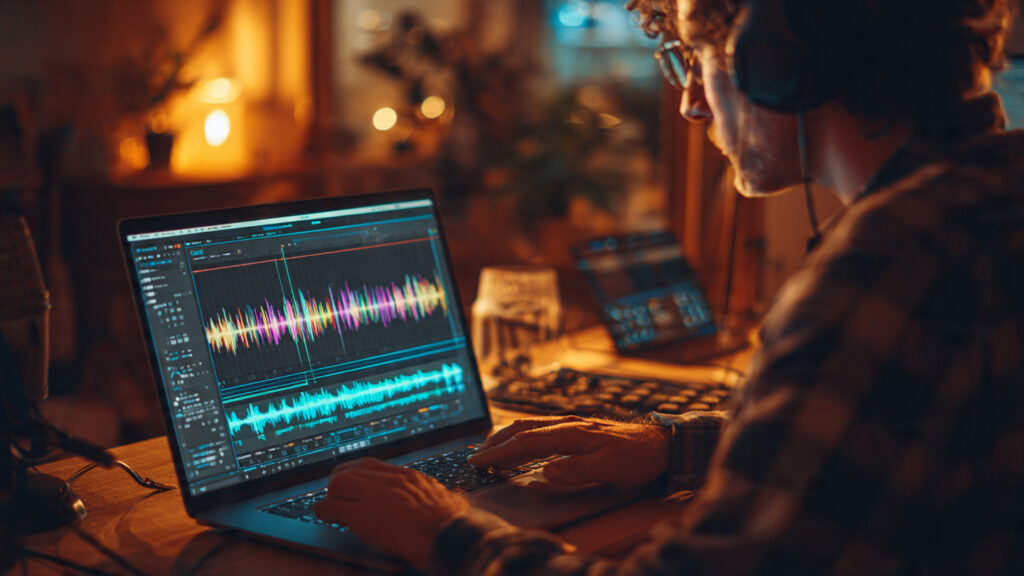
You started your podcast with excitement and vision. You invested in good microphones, set up your recording space, and lined up compelling guests. But then reality hits: every episode requires hours of editing before it’s ready to publish.
“I’ll just do it myself,” you think. “How hard can it be?”
If you’re reading this, you probably already know the answer. What seemed like a money-saving decision has become a time-consuming burden that’s pulling you away from what you do best: creating content and growing your show.
The Hidden Costs You’re Not Counting
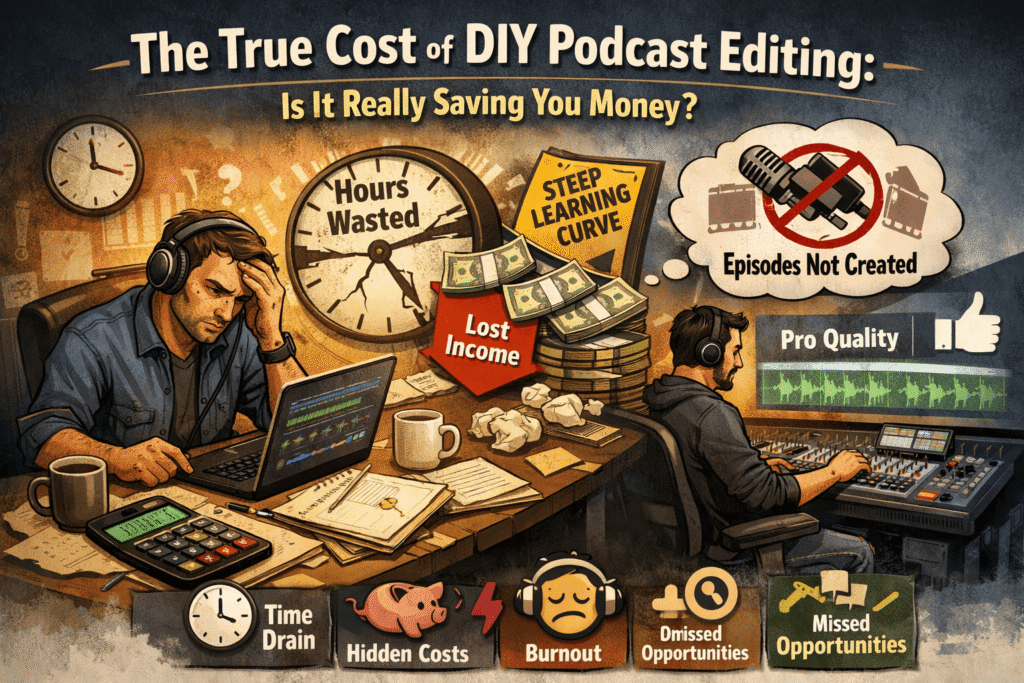
When podcasters calculate the “cost” of DIY editing, they typically only consider the obvious expense: paying someone else versus doing it yourself. But this narrow view misses several critical hidden costs that can actually make DIY editing far more expensive than professional services.
1. Your Time Has a Dollar Value
Let’s do the math honestly. If you spend 3-4 hours editing a 45-minute episode (which is conservative for someone without extensive audio engineering experience), that’s time you’re not spending on:
- Researching and preparing for future episodes
- Reaching out to potential guests
- Marketing your podcast
- Engaging with your audience
- Growing your business or career
If your professional hourly rate is $50 (which is modest for most business owners and consultants), those 4 hours of editing represent $200 of your time per episode. That’s $800 per month for a weekly show, often more than professional editing services cost.
2. The Learning Curve Tax
Audio editing software isn’t intuitive. Whether you’re using Audacity, Adobe Audition, or Descript, there’s a steep learning curve. You’ll spend hours:
- Watching tutorial videos
- Figuring out keyboard shortcuts
- Learning about EQ, compression, and noise gates
- Troubleshooting technical issues
- Redoing sections when you make mistakes
These aren’t one-time costs either. Software updates, new plugins, and evolving best practices mean continuous learning. Professional editors stay current on these developments because it’s their job. For you, it’s just another task on an already overwhelming to-do list.
3. Inconsistent Quality Hurts Growth
Here’s an uncomfortable truth: your editing probably isn’t as good as you think it is. And listeners notice.
When audio levels fluctuate between segments, background noise isn’t properly removed, or awkward pauses kill the flow, listeners tune out. They might not consciously think “the editing is bad,” but they’ll feel something is “off” and simply stop subscribing.
Professional editors bring:
- Trained ears that catch issues you’ll miss
- Specialized tools and plugins
- Years of experience knowing what works
- Consistent quality across every episode
This consistency is what transforms casual listeners into loyal subscribers, the kind who leave reviews, share episodes, and stick around for years.
4. Opportunity Cost: The Episodes You’re Not Making
Perhaps the biggest hidden cost is the content you’re not creating. Every hour spent editing is an hour not spent:
- Recording bonus episodes
- Creating video content from your audio
- Launching that second podcast you’ve been planning
- Building relationships with influencers in your niche
If additional content could grow your audience by even 20%, the revenue potential far exceeds any editing costs. Yet most DIY podcasters are stuck in a hamster wheel, barely keeping up with their current publishing schedule.
5. The Burnout Factor
Podcasting should be energizing, not exhausting. When editing becomes a dreaded chore that you procrastinate on, it affects everything:
- Your episode quality suffers (you rush through it)
- Your publishing schedule becomes inconsistent
- Your enthusiasm for podcasting wanes
- You start questioning whether it’s all worth it
We’ve seen talented podcasters quit entirely, not because they didn’t love creating content, but because the technical burden became overwhelming. That’s the ultimate cost: losing your show completely.
When DIY Editing Makes Sense (And When It Doesn’t)
To be fair, there are scenarios where DIY editing is appropriate:
DIY might work if:
- You’re genuinely passionate about audio engineering as a hobby
- Your podcast is purely recreational with no growth goals
- You have extensive free time and audio production skills
- You’re recording very short episodes (under 15 minutes) with minimal editing needs
Outsourcing makes sense if:
- Your time is valuable and better spent on content creation
- You want consistent, professional-quality audio
- You’re serious about growing your audience
- You publish regularly (weekly or more frequently)
- You’re monetizing your podcast or using it for business development
What Professional Editing Actually Includes
Many podcasters don’t realize the full scope of what professional editors provide. It’s not just “removing the ums.” A quality editing service typically includes:
Audio Enhancement:
- Noise reduction and removal of background sounds
- Volume leveling and normalization to industry standards
- EQ adjustment for optimal voice clarity
- Compression for consistent audio levels
- De-essing and mouth noise removal
Content Editing:
- Removal of false starts, long pauses, and verbal fillers
- Tightening conversations for better pacing
- Cutting out off-topic tangents (when appropriate)
- Ensuring smooth transitions between segments
Production Elements:
- Adding intro and outro music
- Inserting mid-roll ad placements
- Creating smooth transitions between segments
- Embedding chapter markers for enhanced listener experience
Post-Production Deliverables:
- Properly formatted audio files for all platforms
- ID3 tags and metadata
- Multiple file formats if needed
- Timestamped show notes
- Audiograms and social media clips
When you consider everything included, professional services often deliver exceptional value, especially compared to the actual cost of your time.
Real Podcaster Stories: The Cost of Waiting
Sarah, a business consultant, spent six months editing her own show. She estimates she invested 200+ hours and published only 20 episodes. When she finally outsourced editing, she immediately increased to weekly publishing and grew her audience 300% in the next six months. More importantly, the podcast started generating client leads, something that never happened when she was inconsistent.
Mark, a tech entrepreneur, calculated he was “saving” $400 per month by DIY editing. But when he tracked his time honestly, he discovered editing was consuming 20 hours monthly, time worth over $2,000 at his consulting rate. Switching to professional editing was actually a $1,600 monthly profit, not an expense.
Making the Smart Investment Decision
The question isn’t whether you can edit your own podcast, it’s whether you should. And the answer depends on what you value most: your time, your growth, and your sanity.
Consider this framework:
- Calculate your true hourly rate (What could you earn doing what you’re best at?)
- Track your editing time honestly (Don’t forget setup, learning, and frustration time)
- Assess the quality gap (Listen to professionally edited shows in your niche, be honest about the difference)
- Consider your growth goals (What would an extra 20 hours per month enable you to create?)
- Factor in the enjoyment factor (Life’s too short to spend it doing tasks you dread)
The Path Forward
If you’ve realized that DIY editing is costing you more than professional services, you’re not alone. The most successful podcasters we work with didn’t build their shows by being audio engineers, they built them by being great at their niche and letting specialists handle the technical details.
Think of it this way: you wouldn’t bake your own bread to save money if you were running a restaurant. Your expertise is creating compelling content and connecting with your audience. Let editors do what they do best, so you can focus on what you do best.
The podcasts that win aren’t the ones with hosts who know every detail of audio compression ratios. They’re the ones with hosts who show up consistently, create valuable content, and build genuine connections with their audience.
Your time is your most valuable asset. Invest it wisely.
Ready to reclaim your time and elevate your podcast quality? Professional editing isn’t an expense, it’s an investment in your show’s growth and your own sanity. When you stop fighting with waveforms and start focusing on creating great content, everything changes.
What’s your biggest podcast editing challenge? Have you calculated the true cost of your DIY approach? Share your experience in the comments below.